Choosing between a Hiab crane truck and a mobile crane in Dubai depends on more than the load’s weight. A Hiab crane truck can lift, transport and place cargo using one vehicle, while a mobile crane is primarily designed for dedicated lifting operations that may require greater capacity, height or reach. The correct option depends on the complete job, including cargo dimensions, working radius, site access and final placement point.
This guide provides a practical Hiab crane truck vs mobile crane comparison to help businesses, contractors and project teams understand which option may suit their lifting and transport requirements in Dubai.
Key Takeaways
- Choose a Hiab crane truck when cargo needs to be lifted, transported and positioned using one vehicle.
- Consider a mobile crane when the main requirement is a dedicated heavy, high or long-reach lift.
- Never select equipment using load weight alone; working radius can significantly affect lifting capacity.
- Check access, parking, stabilizer space, ground conditions and overhead restrictions at the site.
- Provide cargo dimensions, photographs and exact lifting requirements before requesting equipment.
In This Guide
- Quick comparison and answer
- What a Hiab crane truck is
- What a mobile crane is
- Main differences
- When to choose a Hiab crane truck
- When to consider a mobile crane
- Capacity, height and working radius
- Dubai site-access requirements
- Cost and logistics considerations
- Information required before booking
- Common selection mistakes
- Frequently asked questions
Hiab Crane Truck vs Mobile Crane: Quick Answer
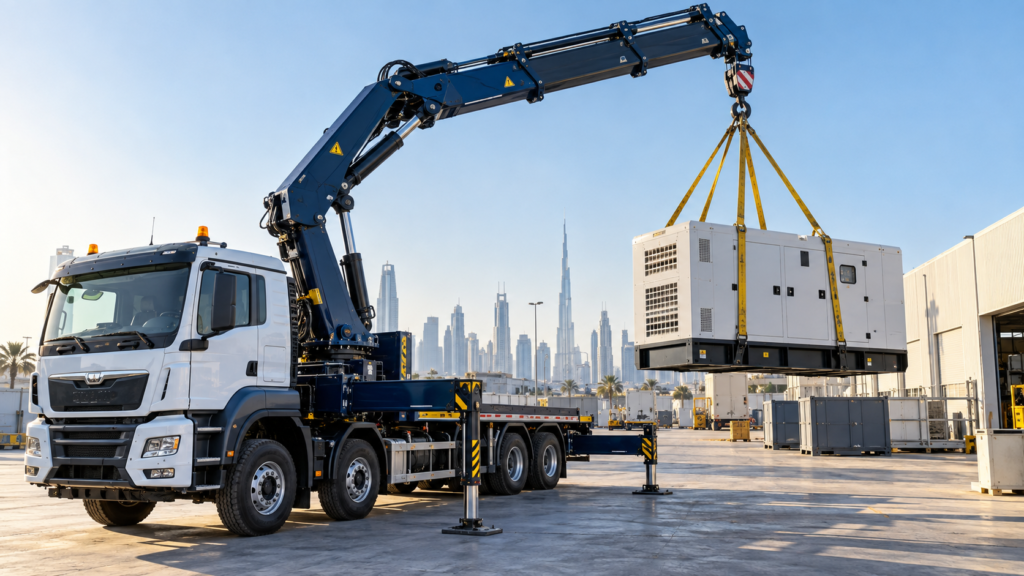
A Hiab crane truck is generally suitable when the same vehicle must collect cargo, lift it onto the truck, transport it and unload or position it at the destination. It can simplify jobs involving generators, machinery, steel, pipes, construction materials and other transportable cargo.
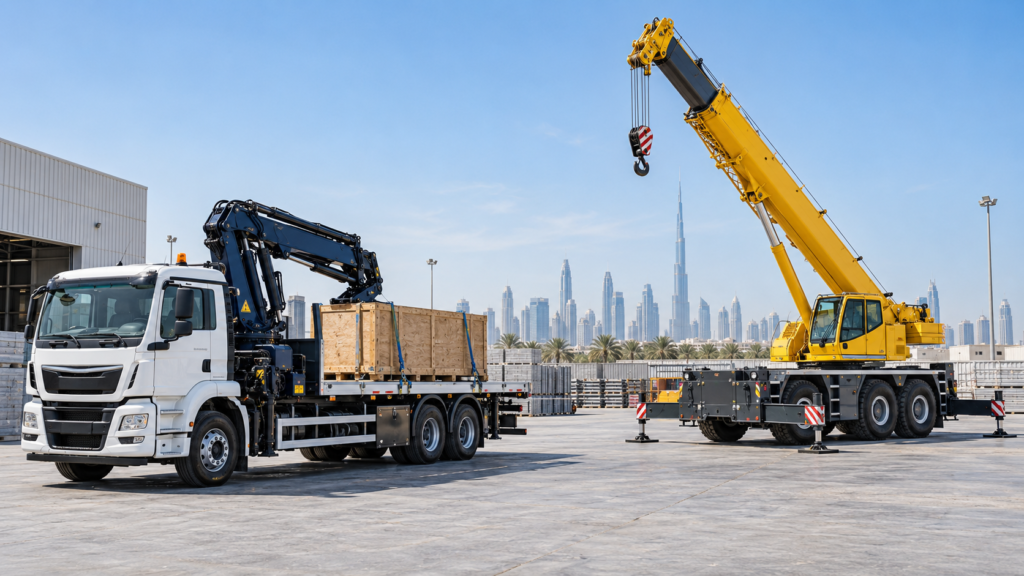
A mobile crane is generally considered when lifting is the main operation and the job requires greater lifting capacity, increased height, longer working radius or a dedicated crane configuration. Separate transportation may be required to bring the cargo to or from the lifting site.
Important: This is a general comparison, not an equipment-capacity approval. The final selection must be based on the actual crane model, manufacturer load chart, working radius, boom configuration, ground conditions and site assessment.
What Is a Hiab Crane Truck?
A Hiab crane truck is a commercial truck fitted with a hydraulic loader crane. The articulated crane is normally mounted behind the cab or toward the rear of the vehicle, while the truck body provides space for carrying cargo.
Although HIAB is a manufacturer and brand name, the word “Hiab” is commonly used in the transport industry to describe truck-mounted loader or knuckle-boom cranes. Their combined lifting and transportation capability makes them useful for deliveries where cargo must be collected and carefully positioned.
Depending on the vehicle and crane configuration, a Hiab crane truck may be used for loading machinery, generators, fabricated structures, pipes, steel sections, air-conditioning equipment and construction materials. It can reduce coordination because one vehicle performs several connected stages of the job.
What Is a Mobile Crane?
A mobile crane is a dedicated lifting machine built on a wheeled carrier. Many mobile cranes use a telescopic boom and can be configured with different boom lengths, jibs, counterweights and support arrangements according to the lift.
Unlike a typical Hiab crane truck, its principal function is lifting rather than carrying project cargo on a loading bed. This makes a mobile crane relevant for jobs involving heavier loads, increased lifting heights, longer working radii or repeated lifting from a fixed position.
The required mobile-crane capacity cannot be determined from the load weight alone. Crane configuration, boom length, working radius, counterweight, support position and ground conditions must all be assessed.
Hiab Crane Truck vs Mobile Crane Comparison
| Comparison Point | Hiab Crane Truck | Mobile Crane |
|---|---|---|
| Primary purpose | Combined cargo lifting and transportation | Dedicated lifting operation |
| Cargo transport | Can carry suitable cargo on the truck body | Cargo normally requires separate transport |
| Typical job | Collect, transport, unload and position cargo | Heavy, high or long-reach lifting at a site |
| Setup | Usually compact, but still requires safe stabilizer space | May require a larger setup area, supports and counterweight planning |
| Reach and capacity | Depends on the loader-crane model and working radius | Broader configurations may be available for demanding lifts |
| Number of vehicles | One vehicle may perform transport and lifting | A separate truck may be needed for the cargo |
| Best suited to | Transport jobs that also require controlled lifting | Projects where lifting is the main requirement |
When Should You Choose a Hiab Crane Truck?
A Hiab crane truck can be the practical choice when cargo must travel between two locations and lifting is required at one or both ends. Instead of arranging one truck for transportation and another machine for lifting, the combined vehicle may complete the full movement.
Consider a Hiab crane truck when:
- The cargo must be collected, transported and unloaded.
- The load is within the truck and crane’s confirmed operating limits.
- The pickup and delivery sites provide suitable vehicle access.
- The crane has sufficient capacity at the required working radius.
- The cargo must be placed on a foundation, platform or designated ground position.
- Reducing coordination between separate transport and lifting providers is important.
For example, moving a generator from a warehouse to a commercial property may involve lifting it at the collection point, securing it on the truck, transporting it and placing it near its installation area. A correctly selected Hiab crane truck may handle these stages as one coordinated operation.
Read our detailed guide on how to choose the right Hiab crane truck in Dubai for the seven checks required before booking.
When Should You Consider a Mobile Crane?
A mobile crane may be more appropriate when lifting performance is the main concern and the job falls outside the safe working capability of an available Hiab crane truck. This could involve significantly heavier cargo, greater height, longer horizontal reach or a lift over substantial obstructions.
A mobile crane may need to be assessed when:
- The required load exceeds the confirmed Hiab capacity at the working radius.
- The load must be lifted to a considerable height.
- The crane must reach across a building, wall or large obstruction.
- A dedicated crane must remain on site for several lifts.
- The project requires a particular boom, jib or counterweight configuration.
- The lift plan specifies dedicated mobile-crane equipment.
The cargo may still require a separate flatbed, trailer or other transport vehicle. This means the lifting and transportation schedules must be coordinated so both resources arrive when the site is ready.
Compare Capacity, Height and Working Radius
One of the most common mistakes is comparing cranes only by their advertised maximum capacity. That figure normally applies under specific operating conditions and does not mean the crane can lift the same weight at every boom extension.
Working radius is the horizontal distance between the crane’s centre of rotation and the load. As this distance increases, available lifting capacity generally decreases. Lifting height, boom angle and crane configuration also affect the operation.
Before equipment is selected, provide:
- The verified or best available cargo weight
- Complete length, width and height
- Distance from the truck or crane position to the load
- Required final placement height
- Walls, fences, buildings or equipment between the crane and load
- Available lifting points and centre-of-gravity information
The transport or lifting provider should use these details to review the relevant equipment configuration and load chart. Manufacturer information for truck-mounted knuckle-boom cranes and telescopic mobile cranes also demonstrates why crane capabilities vary by model and configuration.
Check Dubai Site Access and Setup Requirements
The technically strongest crane is not useful if it cannot safely reach or set up at the site. Dubai projects can involve industrial yards, warehouses, construction sites, villas, commercial buildings and busy roadside locations, each with different restrictions.
Check the following at both the pickup and delivery locations:
- Gate width and height clearance
- Turning and reversing space
- Safe parking position
- Space for outriggers or stabilizers
- Ground strength, slope and surface condition
- Overhead cables, canopies, trees or structures
- Nearby vehicles, pedestrians and work activities
- Building-management or construction-site access approval
A compact Hiab crane truck may be easier to position for some delivery jobs, but it still requires sufficient stabilizer clearance and safe ground support. A mobile crane may require a larger controlled working area depending on its size and configuration.
Planning tip: Send clear photographs or a short video showing the entrance, parking position, cargo and final placement area. This can reveal access restrictions that are difficult to explain over the phone.
Compare the Complete Cost and Logistics
The lowest equipment rate does not always produce the lowest total project cost. Compare the complete operation rather than looking at only the crane or truck price.
A Hiab crane truck may reduce coordination where one suitable vehicle can perform loading, transportation and unloading. A mobile-crane operation may involve separate cargo transport, crane mobilization, site preparation and scheduling between multiple teams.
Pricing can be affected by:
- Equipment type and required capacity
- Pickup and delivery distance
- Time required for loading and unloading
- Working radius and lifting complexity
- Site waiting time and access restrictions
- Additional labour, rigging or lifting accessories
- Permits or controlled-site requirements where applicable
- Night, weekend or urgent scheduling requirements
Request a quotation based on complete job details. An unrealistically low estimate caused by missing information can lead to delays or equipment changes after arrival.
Information to Provide Before Booking
Crane and Transport Enquiry Checklist
- Cargo description and quantity
- Accurate or estimated weight
- Complete cargo dimensions
- Clear cargo photographs
- Pickup and delivery locations
- Required lifting height and horizontal reach
- Photographs of site access and placement area
- Preferred collection date and time
- Available lifting points or handling instructions
- Site contact and entry requirements
If the weight or lifting radius is unknown, do not guess. Share equipment specifications, supplier documentation, drawings or photographs so the missing information can be identified before scheduling.
Common Mistakes When Selecting Lifting Equipment
Selecting by Load Weight Alone
A crane that can lift a particular weight close to the vehicle may not lift it at a longer radius. Weight, reach and height must be reviewed together.
Ignoring Cargo Dimensions
Long, wide or irregular cargo may need additional truck space, lifting points, rigging and control even when its total weight appears manageable.
Assuming the Crane Can Park Beside the Load
Walls, parked vehicles, landscaping and site rules may force the equipment farther away, increasing the working radius and changing the available capacity.
Booking Before Confirming Access
Narrow entrances, weak surfaces or insufficient stabilizer space may prevent safe setup. Both locations should be checked before dispatch.
Choosing the Cheapest Initial Option
Equipment that cannot complete the lift safely can create waiting charges, rescheduling and additional mobilization. Suitable equipment should be selected before comparing final quotations.
Frequently Asked Questions
Is a Hiab crane truck the same as a mobile crane?
No. A Hiab crane truck normally combines a loader crane with a truck body that can carry suitable cargo. A mobile crane is primarily a dedicated lifting machine and does not normally replace the cargo-transport vehicle.
Can a Hiab crane truck lift and transport machinery?
It may lift and transport machinery when the weight, dimensions, working radius, truck payload and site conditions are within the confirmed equipment limits. Exact job details must be reviewed before booking.
Which option is better for a heavy lift?
The answer depends on the actual load and lifting radius. A dedicated mobile crane may be required for loads, heights or reaches beyond the capability of an available Hiab crane truck, but the decision must be based on an equipment-specific assessment.
Is a Hiab crane truck more economical than a mobile crane?
It can be more efficient for suitable jobs because one vehicle may handle lifting and transport. However, total cost depends on equipment capacity, distance, working time, access, waiting time and job complexity.
What information is needed for a crane-truck quotation?
Provide cargo weight, dimensions, photographs, pickup and delivery locations, lifting height, horizontal reach, access conditions and preferred schedule. These details help determine whether the proposed equipment is suitable.
Choose Equipment for the Complete Operation
The right choice in a Hiab crane truck vs mobile crane comparison depends on the complete operation—not simply the largest capacity number. Consider whether cargo transport is required, how far and how high the load must be lifted, where the equipment can park and whether the site provides safe setup space.
Saeed Noor Trucks Transport L.L.C. provides Hiab crane truck services in Dubai for suitable lifting, loading, transportation and cargo-placement requirements. Share your complete job details so the transport team can review the requirement before scheduling.
Need a Hiab Crane Truck in Dubai?
Send your cargo weight, dimensions, photographs, pickup location, delivery point and lifting requirements for assistance with your transport enquiry.