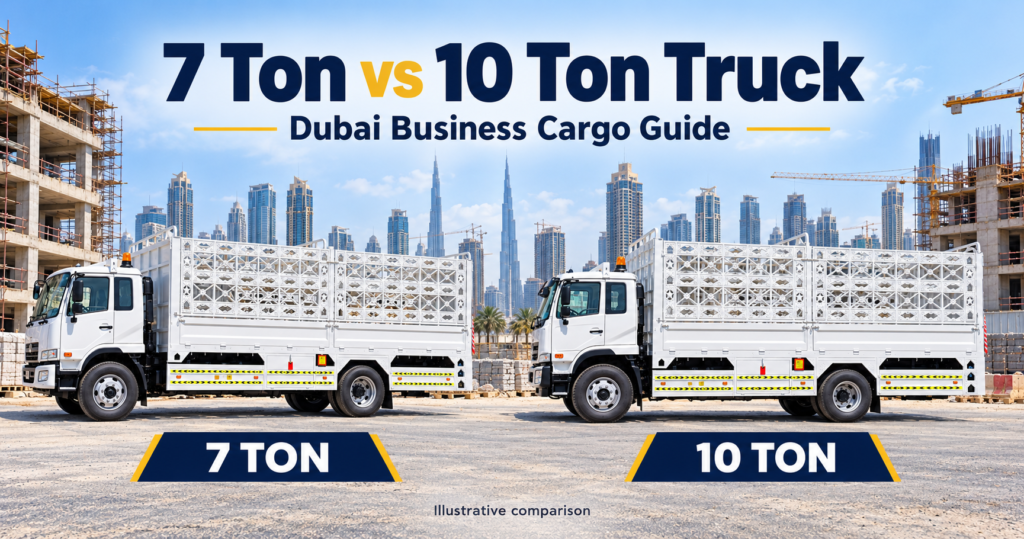
The choice between a 7 ton vs 10 ton truck for Dubai business cargo depends on what the complete shipment needs—not simply which vehicle sounds larger. Check the loaded weight, the heaviest individual item, the floor space required, and the loading arrangements at both ends. A 7-ton option may suit a manageable commercial consignment; a 10-ton option may be worth assessing when consolidation or heavier industrial goods change the job.
This guide focuses on warehouse transfers, mixed industrial consignments, packaged construction supplies and project deliveries. It explains how to compare two proposed vehicles, identify a load that cannot be split, and decide whether one larger movement is more practical than several smaller ones.
Truck names used in rental enquiries are categories, not a guarantee of identical cargo dimensions or usable payload. Before dispatch, Saeed Noor Trucks Transport L.L.C. needs the actual cargo and site details to assess a suitable transport arrangement. This article does not publish unconfirmed company vehicle specifications or fixed rental prices.
Key Takeaways
- Check the total shipment and the heaviest single item separately.
- Use the usable cargo floor and stacking limitations to assess fit.
- Compare complete delivery quotations, including handling and waiting arrangements.
- Confirm the proposed vehicle, loading equipment and receiving slot before dispatch.
In This Guide
Quick Answer: 7 Ton vs 10 Ton Truck
Choose between a 7 ton vs 10 ton truck by confirming whether the complete cargo fits the actual vehicle’s weight allowance, loading space and handling arrangements. Assess a 10-ton option when a suitable 7-ton vehicle cannot accommodate the consignment or when a larger delivery avoids an impractical split. Neither category automatically confirms access, lifting capability or a cheaper overall job.
1. Check the Shipment, Not Just Its Total Weight
Start with an itemised cargo list. A shipment made up of many small packages creates different planning choices from a single machine of the same combined weight. Include pallets, crates and other packaging in the information supplied. Record whether each item can be separated, rotated or stacked; those answers affect the loading plan.
The heaviest item can determine the vehicle
Dividing a total weight across several trips only works if the cargo can actually be divided. A single machine cannot be treated as several smaller loads without an approved dismantling arrangement. Give the transport team its individual weight and dimensions, including its base or transport frame. If the weight is uncertain, obtain a manufacturer document, packing list or other reliable record before vehicle selection.
Cargo footprint matters as much as volume
A cubic-volume estimate can hide a practical problem. Several wide, non-stackable units may fill the cargo floor even when there is empty space above them. Record each unit’s packed length and width, whether it must remain upright, and any clearance needed for handling or securing. Do not use the truck’s overall length as the length available for goods.
Manufacturer data also needs careful interpretation. Isuzu UAE’s F-Series specifications note that the published payload includes rear-body weight. This illustrates why chassis figures should not be treated as a finished vehicle’s cargo allowance. Ask the provider to confirm the usable allowance and body measurements of the specific truck proposed for your booking.
2. Compare the Proposed 7-Ton and 10-Ton Vehicles
Request a comparison against the same cargo list and the same delivery instructions. A useful quote identifies what is suitable for the job; a category name alone leaves too many questions unanswered. The following matrix is a planning guide, not a specification sheet for every truck.
| Decision factor | Assess a 7-ton option when… | Assess a 10-ton option when… |
|---|---|---|
| Loaded weight | The complete load is within the confirmed vehicle allowance. | A suitable larger vehicle is needed for the actual loaded weight. |
| Non-stackable cargo | The required footprint fits the proposed cargo body. | More usable floor space is needed; confirm actual body dimensions. |
| Indivisible items | Each item and its support arrangement suit the vehicle. | A heavier single item requires a different vehicle assessment. |
| Shipment consolidation | One suitable trip or a workable split meets the schedule. | One consolidated delivery can avoid a disruptive second movement. |
| Site access | The actual truck can reach and leave the loading points. | The proposed larger vehicle has been checked against both sites. |
| Loading method | Suitable loading and unloading are available. | Handling equipment and arrangements are also suitable for the larger job. |
Important: A 10-ton category does not automatically provide a longer body, a crane, a tail lift or suitable clearance. Confirm the complete configuration. An unsuitable loading method is not solved merely by choosing a higher tonnage.
3. Practical Industrial Cargo Examples
The examples below are illustrative planning situations, not records of jobs completed by our company.
Mixed warehouse stock with non-stackable items
A business needs to move cartons, crated fittings and display units together. The combined weight may appear manageable, but the display units cannot support other goods. Compare their total floor-space requirement against the available body. A suitable 7-ton truck may work if the layout fits; otherwise assess a different configuration or a 10-ton option rather than assuming stacking will solve the problem.
A machine plus its separate accessories
A workshop transfer includes one machine, a control cabinet and boxed accessories. Check the machine separately: its weight, base footprint, handling points and whether it must remain upright. The smaller accessories do not make the machine easier to transport. Vehicle selection also needs an appropriate loading method and a supported placement plan, assessed by the people responsible for handling.
Packaged supplies arriving at one project slot
A supplier can separate a consignment into smaller batches, but the receiving site offers one booked unloading window. Compare whether a single suitable larger movement simplifies receiving, or whether separate deliveries can be arranged without leaving a truck waiting. The right answer depends on access, available equipment and the receiving team—not just the number of packages.
4. Compare Consolidation With Split Deliveries
One larger trip is useful only when the whole load fits and the destination can receive it. Splitting a delivery may be practical when items are divisible and the receiving site can handle separate movements. It can be less useful when it creates repeat handling, missed appointments or a second vehicle waiting for the same unloading equipment.
A Practical Decision Sequence
- Confirm the complete cargo list and individual item weights.
- Check usable loading space and a feasible placement arrangement.
- Confirm loading and unloading equipment at both locations.
- Compare one-trip and split-delivery schedules with the receiving team.
- Request complete quotations against the same scope.
- Confirm the selected vehicle and any site requirements before dispatch.
If the shipment is smaller than expected, our 3 ton vs 7 ton pickup guide explains the next size comparison. It is a separate decision from consolidating heavier industrial cargo into a 7-ton or 10-ton movement.
5. Check Dubai Site Access and Receiving Arrangements
For a warehouse in Al Qusais, an industrial unit in Al Quoz or a project delivery elsewhere in Dubai, share the exact loading entrance rather than only the building address. The correct entrance, parking position and receiving contact help the transport team review the job. A map pin alone may lead to an office entrance instead of the cargo gate.
- Gate width, height clearance and any covered approach.
- Turning space and a place to stand during loading.
- Loading-bay or receiving appointment requirements.
- Site-entry instructions and documents requested by the receiving team.
- Whether both locations can accept the proposed vehicle configuration.
Ask the transport provider to check route and timing requirements for the actual vehicle and journey. This guide does not prescribe a universal Dubai truck timetable: route conditions and applicable requirements should be confirmed for the booking. If a site cannot receive the vehicle, plan a suitable alternative before dispatch.
6. Plan Loading, Securing and Weight Distribution
A vehicle being within its overall load allowance does not settle how the goods should be placed. Concentrated heavy items, uneven loading and unsuitable support arrangements need assessment. Provide the weight and dimensions of individual units so the responsible transport and handling team can consider placement, vehicle limits and securing requirements.
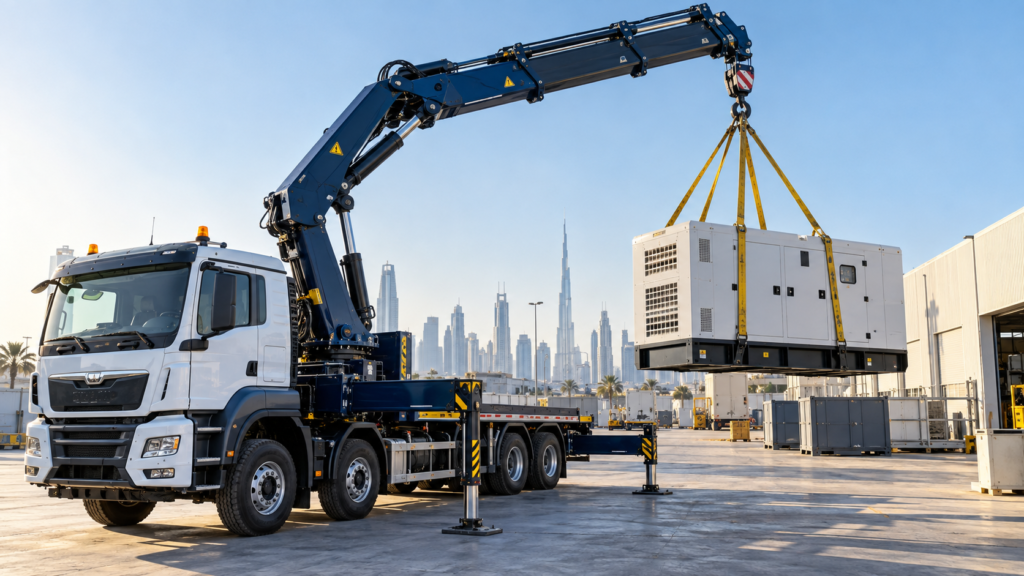
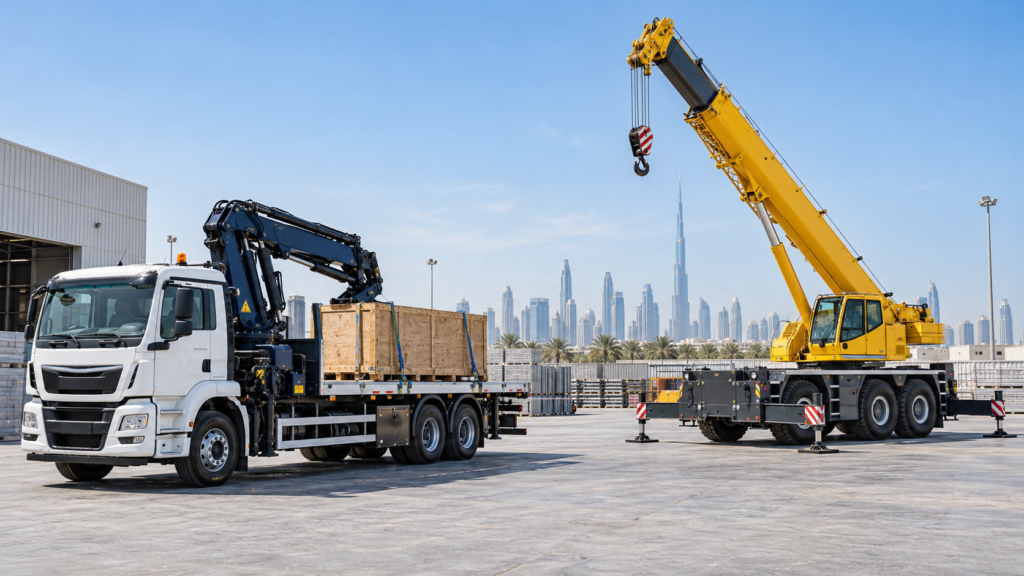
Confirm who provides the forklift, crane or other loading equipment, and who is responsible for arranging it at the destination. A standard transport truck should not be assumed to include lifting machinery. If the job requires combined lifting and transport, review our HIAB crane truck service and provide the lifting requirements for a separate suitability assessment.
Keep fragile and heavy items identified in the cargo list. Share handling instructions from the supplier where available. Do not use this general guide as a lifting plan or attempt to resolve unusual machinery handling through a truck-size label.
7. Compare Complete Quotations, Not Headline Prices
A useful 7-ton versus 10-ton cost comparison uses the same pickup point, destination, cargo, schedule and handling scope. A lower initial transport figure may describe a different job. Ask what the quotation includes and what would change if the cargo details or receiving arrangements change.
- One trip or multiple trips, including any additional collection points.
- Loading and unloading arrangements, labour and equipment responsibilities.
- Expected waiting time and how delays are handled in the quotation.
- Required date, receiving slot and any special scheduling.
- Cargo dimensions, packaging and special handling instructions.
- Any applicable charges stated by the provider for the proposed journey.
Do not assume the larger truck always costs more overall, or that it always saves money. Compare the complete proposed arrangements. Share cargo photographs and a packing list so both options can be assessed against the same information.
Common Mistakes to Avoid
- Treating a category name as an exact specification.
- Comparing only combined weight while ignoring a heavy single item.
- Assuming non-stackable cargo can use the full cubic volume.
- Assuming both sites have suitable unloading equipment.
- Booking a larger truck without checking the actual access route.
- Comparing quotes that cover different trips or handling responsibilities.
8. Send a Booking Enquiry That Supports a Real Decision
Instead of asking only for the cheapest 7-ton or 10-ton truck, send enough information for the provider to recommend a workable arrangement. If a figure is estimated, label it as an estimate and explain how it was obtained.
Cargo and Delivery Checklist
- Cargo description, item count and packing list if available.
- Total packed weight and the heaviest individual item.
- Packed length, width and height for each significant unit.
- Stacking restrictions and upright-only instructions.
- Clear photographs showing the cargo and transport base.
- Exact pickup and delivery locations, loading gates and site contacts.
- Loading and unloading equipment available at each end.
- Preferred date, receiving slot and whether split deliveries are acceptable.
- Any site instructions or special handling requirements.
Saeed Noor Trucks Transport L.L.C. publishes dedicated 7 ton truck transport and 10 ton truck transport pages. Use them to review the relevant service, then share your actual consignment for assessment rather than assuming a category confirms suitability.
Frequently Asked Questions
What is the main difference between a 7 ton and 10 ton truck?
They are different commercial transport categories, but the practical difference depends on the proposed vehicles. Compare usable cargo allowance, body dimensions, loading configuration and access. A 10-ton option may be assessed for heavier or more consolidated cargo; its name alone does not confirm suitability.
Can a 10 ton truck carry exactly 10,000 kg of my goods?
Do not assume this from the category name. Confirm the actual vehicle’s usable cargo allowance, fitted body and other relevant limits with the provider. Manufacturer figures can be presented differently from finished-vehicle cargo capacity, so the specific vehicle needs to be checked.
What if my total shipment fits but one machine is very heavy?
Provide the individual machine weight and its base dimensions. Total shipment weight does not establish whether its concentrated load, placement and handling arrangements are suitable. The transport and handling team should assess it separately before confirming the vehicle.
Is one 10 ton trip better than two 7 ton trips?
It can be more practical when one suitable vehicle can carry everything and the destination can receive it. Split trips can also work when cargo is divisible and the schedule permits. Compare the complete handling scope, appointments and quotations; there is no universal price advantage.
How many pallets fit in a 7 ton or 10 ton truck?
There is no reliable universal count. Pallet dimensions, loaded weight, stacking permissions and the actual cargo body determine the answer. Supply the pallet count and measurements, then ask the provider to confirm a feasible layout for the proposed vehicle.
Does a 10 ton truck include a crane or tail lift?
The truck-size category does not confirm loading equipment. Ask for the actual configuration and who supplies equipment at both ends. If lifting is needed, share the cargo and lifting requirements so an appropriate equipment arrangement can be assessed.
What should I send if I am unsure which truck to book?
Send the packed cargo list, total and individual weights, dimensions, photographs, loading arrangements and both site details. State your delivery deadline and whether the load may be split. Those details let the provider assess options instead of guessing from the cargo name.
Final Recommendation
For a 7 ton vs 10 ton truck decision, verify the complete shipment and the proposed vehicle together. Give special attention to indivisible heavy items, non-stackable footprint, suitable loading equipment and the receiving schedule. Select the arrangement that fits the entire delivery, rather than choosing by tonnage alone.
Need Help Choosing a Truck for Business Cargo?
Share your cargo list, packed weight, dimensions, pickup point, delivery location and required schedule with Saeed Noor Trucks Transport L.L.C. Ask our team to assess the relevant vehicle and transport arrangements for your job.